

TALAPRO-3: A Major rPFS Win in HRR-Mutated mCSPC, But Which Patients Benefit Most?

Key Points
- TALAPRO-3 demonstrated a significant radiographic progression-free survival (rPFS) benefit with talazoparib plus enzalutamide in homologous recombination repair (HRR)-mutated metastatic castration-sensitive prostate cancer (mCSPC).
- Non-BRCA HRR-altered patients also derived meaningful benefit, although gene-specific heterogeneity highlights the need for nuanced interpretation.
- Overall survival (OS) data remain immature, but pooled analyses with similar trials suggest a potential emerging survival advantage for androgen-receptor pathway inhibitor (ARPi) plus PARPi.
- High rates of grade 3 or 4 anemia and transfusion requirements emphasize the importance of careful patient selection, early monitoring, and proactive toxicity management.
Androgen deprivation therapy (ADT) combined with an ARPi has become a well-established standard of care for patients diagnosed with mCSPC. For patients whose tumors harbor HRR gene alterations (mHRR), roughly one in four men with metastatic prostate cancer, outcomes with ADT/ARPi doublet remain poor compared with HRR-intact patients, highlighting the need for more effective upfront strategies.
Results from the phase 3 TALAPRO-3 study, presented at the 2026 American Society of Clinical Oncology (ASCO) Annual Meeting and simultaneously published in the New England Journal of Medicine, demonstrated that the addition of talazoparib (TALA) to enzalutamide (ENZA) prolonged rPFS in patients with mCSPC undergoing treatment with ADT (hazard ratio [HR], 0.48).1 However, gene-specific differences in benefit, an immature OS signal, and a notable hematologic toxicity burden demand careful patient selection and proactive management in clinical practice.
Study Design
TALAPRO-3 (NCT04821622) enrolled nearly 600 patients with mCSPC harboring confirmed HRR gene alterations, randomized 1:1 to talazoparib 0.5 mg/day plus enzalutamide 160 mg/day (TALA plus ENZA) versus placebo plus enzalutamide (PBO plus ENZA), in addition to ADT (all patients). HRR status was confirmed using the FoundationOne Liquid CDx 12-gene panel on blood and/or tumor tissue. Key stratification factors were de novo versus relapsed mCSPC, high- versus low-volume disease, and BRCA versus non-BRCA mutational status.
Notably, the trial design did not incorporate use of docetaxel, and the population was heavily de novo (84%) and high-volume (70%), with BRCA1/2 mutations comprising approximately one-third of enrolled patients. According to discussant David Olmos, MD, PhD, TALAPRO-3 enrolled the largest number of patients harboring ATM mutations of any PARPi trial to date in prostate cancer (n = 167), making its gene-specific subgroup data particularly informative.
Primary End Point: Notable rPFS Benefit
At a median follow-up of approximately 38 months (data cutoff February 18, 2026), TALA plus ENZA reduced the risk of radiographic progression or death by 52% compared with PBO plus ENZA (HR, 0.481; 95% CI, 0.357–0.647; P < .0001). Median rPFS was not reached in the combination arm versus 45.8 months in the control arm—a result that is impressive given enzalutamide alone is already highly active (Figure 1).
As Tian Zang, MD, MHS, said during the Advancements in Oncology session: “They saw a really nice benefit in HRR-selected patients—more than double for rPFS, which is great to see in that patient population.”
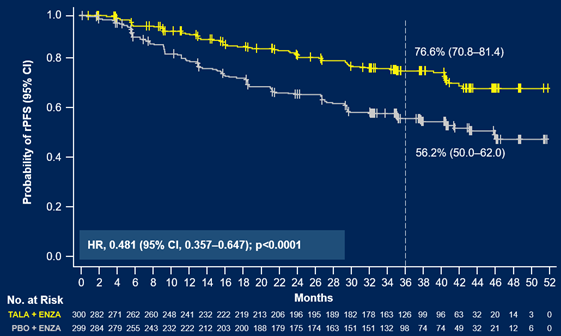
Figure 1. TALAPRO-3 rPFS Data
The benefit was most pronounced in patients with BRCA mutations (HR, 0.36; 63% risk reduction). Based on these data, Dr. Olmos said, “TALAPRO-3 reinforces ARPi plus PARPi as standard of care for BRCA1/2 mCSPC.” Notably, the non-BRCA HRR-altered subgroup also demonstrated meaningful benefit (HR, 0.56; 43% risk reduction).
How to Clinically Interpret Maturing OS Data
Although early in analysis, there was a trend favoring OS with the combination TALA plus ENZA (74 vs 91 deaths; HR, 0.77; 95% CI, 0.56–1.04; P = .09). This prompted a pointed question from Dr. Olmos: “Without clear OS benefit, should we use PARPi in mCSPC or wait until progression to mCRPC?”
To address this, Dr. Olmos presented an exploratory meta-analysis pooling TALAPRO-3 with AMPLITUDE. The two trials showed remarkably similar OS HRs (0.77 and 0.79, respectively), and when combined, produced a statistically significant pooled HR of 0.78 (95% CI, 0.63–0.96; P = .019), suggesting that while individual trials are underpowered to show an OS benefit, the assembling of evidence points toward a meaningful survival advantage for ARPi plus PARPi in mHRR mCSPC. Dr. Olmos acknowledged important caveats: no OS data were stratified by BRCA versus non-BRCA subgroups across trials, and AMPLITUDE enrolled a higher proportion of patients with BRCA mutations (>50%) compared with TALAPRO-3 (35%), which may overestimate the benefit in mHRR non-BRCA patients when analyzed together.1,2
Tolerability: A Real-World Reality Check
The combination’s safety profile demands honest discussion with patients and careful planning in community practice. Grade 3 or 4 treatment-related adverse events occurred in over 70% of patients receiving TALA plus ENZA. Anemia was the most common adverse event (71%), with a median time to grade 3 or 4 onset of 13 weeks. Forty percent of patients required red blood cell transfusions early in treatment (Figure 2).
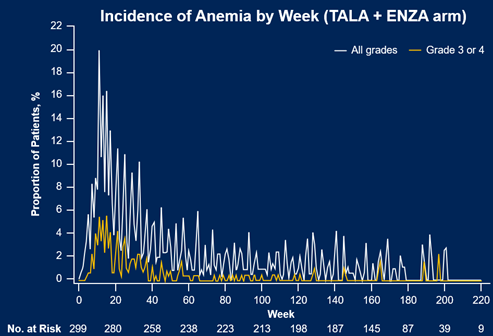
Figure 2. TALAPRO-3 Trial: Anemia Incidence
Five patients in the TALA plus ENZA arm developed either myelodysplastic syndrome or acute myeloid leukemia compared with 1 patient in the control arm. During the Advancements in Oncology session, Rahul Gosain, MD, MBA, of the Oncology Brothers, echoed the practical concern: “For PARP inhibitors, we have to be mindful about that bone marrow suppression.”
The reassuring counterpoint is that proactive management is effective. Protocol-mandated dose reduction of TALA after the first grade 3 or higher anemia episode, combined with transfusion support, allowed 80% or greater of patients to continue treatment without permanent discontinuation. Median treatment duration was virtually identical in patients who did and did not develop severe anemia (34 months vs 36 months), and only 5% of patients discontinued because of anemia.
Implications for Community Practice
Highlighting key clinical considerations, Dr Olmos concluded, “Use of PARPi plus ARPi in mCSPC and mCRPC should be biomarker-driven and based on a balance of benefit versus tolerability.”
For community oncologists, this means testing HRR status at the time of mCSPC diagnosis (not at progression) and interpreting the result as more than a binary positive/negative. Which gene is mutated matters. Patients with mutations in BRCA1/2 have both the greatest expected benefit and the worst outcomes on standard-of-care alone, making them the clearest candidates. Practices should also be prepared for the transfusion burden: establishing hematology support pathways, monitoring closely in the first 3 months, and applying dose-reduction protocols proactively.
TALAPRO-3 is a meaningful step forward. Pending regulatory review, it has the potential to reshape upfront treatment for HRR-altered mCSPC. But as the discussant made clear, a compelling HR is only the beginning. The real work lies in applying these results thoughtfully, identifying which patients have the most to gain, preparing for the toxicity burden, and recognizing the questions this trial leaves unanswered.
References
- Agarwal N, Matsubara N, Azad AA, et al. PARP and androgen-signaling inhibition plus ADT in metastatic prostate cancer. N Engl J Med. 2026. doi:10.1056/NEJMoa2604126
- Attard G, Agarwal N, Graff JN, et al. Phase 3 AMPLITUDE trial: Niraparib (NIRA) and abiraterone acetate plus prednisone (AAP) for metastatic castration-sensitive prostate cancer (mCSPC) patients (pts) with alterations in homologous recombination repair (HRR) genes. J Clin Oncol. 2025;43(17). doi:10.1200/JCO.2025.43.17_suppl.LBA5006