

Integrating ctDNA Into Muscle-Invasive Bladder Cancer Treatment

Key Points
- Detectable circulating tumor DNA (ctDNA) is a strong prognostic marker in muscle-invasive bladder cancer and has become clinically actionable with FDA-approved ctDNA-guided adjuvant atezolizumab following radical cystectomy.
- The phase 3 IMVigor011 trial demonstrated that ctDNA-guided adjuvant atezolizumab significantly improved disease-free survival (DFS) and overall survival (OS) compared with placebo in patients with molecular residual disease.
- Emerging perioperative regimens such as EV-303/304 and NIAGARA are reshaping standard-of-care treatment in MIBC.
- Ongoing and future trials, including risk-adapted studies like MODERN, are evaluating whether ctDNA can guide treatment intensification, de-escalation, and bladder-preserving strategies to refine precision therapy in MIBC.
Detectable ctDNA confers a poorer prognosis in bladder cancer, but until recently was not an actionable biomarker. With the recent FDA approval of ctDNA-guided atezolizumab after radical cystectomy, ctDNA now informs treatment decision-making in muscle-invasive bladder cancer (MIBC). However, several perioperative options have arisen in MIBC, complicating the therapeutic landscape with implications for ctDNA utilization.
IMVigor011 Study Design and Results
IMVigor011 was a randomized, placebo-controlled phase 3 trial that tested a ctDNA-guided strategy in MIBC, which was defined as (y)pT2-4aN0M0 or (y)pT0-4aN+M0 surgical staging.1 Patients who underwent a radical cystectomy and had no radiographic evidence of disease underwent serial ctDNA monitoring using the Signatera CDx assay (Natera, Inc) for 1 year. Those with detectable ctDNA at any point, provided they did not have radiographic disease, were randomized 2:1 to 12 cycles of atezolizumab (n = 167) or placebo (n = 83) every 4 weeks for up to 1 year.
Atezolizumab significantly improved DFS, the study’s primary end point, compared with placebo. Patients receiving atezolizumab had a median DFS of 9.9 months compared with 4.8 months with placebo (Hazard ratio [HR], 0.64; 95% CI, 0.47-0.87). Atezolizumab also improved OS with a median of 32.8 months versus 21.1 months (HR, 0.59; 95% CI, 0.39 – 0.90) with placebo (Figure 1).
Survival data in patients who were persistently ctDNA-negative will also guide practice. Of the 357 patients in this category, DFS was 95% at the end of the 1-year monitoring period and 88% at 2 years.
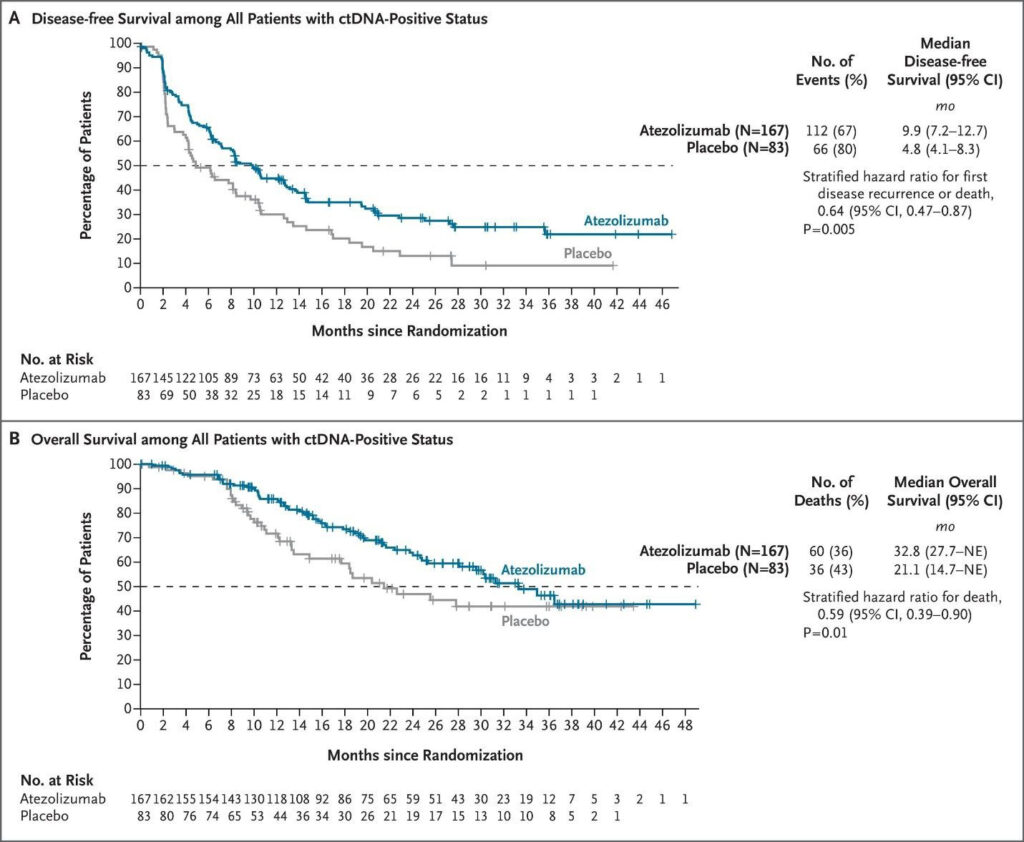
Kaplan-Meier curves showing differences in disease-free survival (A) and overall survival (B) in ctDNA positive MIBC patients who received either atezolizumab or placebo after radical cystectomy
Figure 1. IMVigor011 disease-free and overall survival data
On the strength of the IMVigor011 data, adjuvant atezolizumab received FDA approval in patients with ctDNA molecular residual disease (MRD) as determined by an FDA-authorized test. The Signatera CDx assay was also FDA approved as a companion diagnostic for ctDNA detection in the post-cystectomy setting. Patients with undetectable ctDNA were recommended to continue serial testing until completion of the 12-month testing window.
Role of ctDNA in Modern Perioperative Regimens
The study population of IMVigor011 included patients who had received either upfront radical cystectomy or neoadjuvant platinum chemotherapy. Since this study’s conception, several effective systemic therapies employing different agents and approaches have become standards of care. At the Advancements in Oncology session, Sumanta Pal, MD, FASCO, of City of Hope, said that until recently he had been using the NIAGARA regimen, which incorporates neoadjuvant gemcitabine, cisplatin, and durvalumab and adjuvant durvalumab. Dr. Pal noted the rapid pace of change: “The muscle-invasive bladder cancer space is moving so much. This past year we saw EV-303 (KEYNOTE-905), which was for cisplatin-ineligible populations. We then saw EV-304 or KEYNOTE-B15, which was for cisplatin-eligible patient populations.”
The EV-303 regimen, which administered neoadjuvant and adjuvant enfortumab vedotin (EV) and pembrolizumab to cisplatin (cis)-ineligible patients, is the new standard of care in cis-ineligible MIBC.
EV-304 investigated neoadjuvant and adjuvant EV and pembrolizumab in cis-eligible patients and is poised to become standard of care in cis-eligible MIBC as well.
Andrea Apolo, MD, National Institutes of Health, affirmed the impact of EV-303/304, saying she has “made the switch. I’m giving EV pembro to everybody.”
The IMVigor011 regimen would not be directly applicable in treatment settings where planned adjuvant therapy is administered. However, ctDNA-guided adjuvant atezolizumab could be leveraged to improve patient outcomes in situations with planned adjuvant therapy. Given the duration and toxicity of these regimens, clinicians may recommend adjuvant atezolizumab to ctDNA-positive patients who cannot tolerate further EV or wish to de-intensify therapy. In these scenarios—or where EV-303/304 and NIAGARA regimens are not used—atezolizumab remains a viable treatment option in patients with detectable ctDNA.
While EV-303 and EV-304 have not yet reported ctDNA analyses, the prognostic value of ctDNA in perioperative regimens was showcased in NIAGARA. At ASCO 2025, Thomas Powles, MD, MBBS, MRCP, Barts Cancer Institute, presented data showing that ctDNA-negative status (n = 255) conferred a HR of 0.09 for DFS compared with ctDNA-positive status (n = 17) after radical cystectomy (Figure 2).2
Even before cystectomy, persistent ctDNA after neoadjuvant therapy was also unfavorable compared with ctDNA clearance (HR, 0.32; 95% CI, 0.22-0.47). These data and IMVigor011 results reaffirm the prognostic relevance of ctDNA and raise questions as to whether ctDNA can refine treatment selection in modern perioperative regimens.
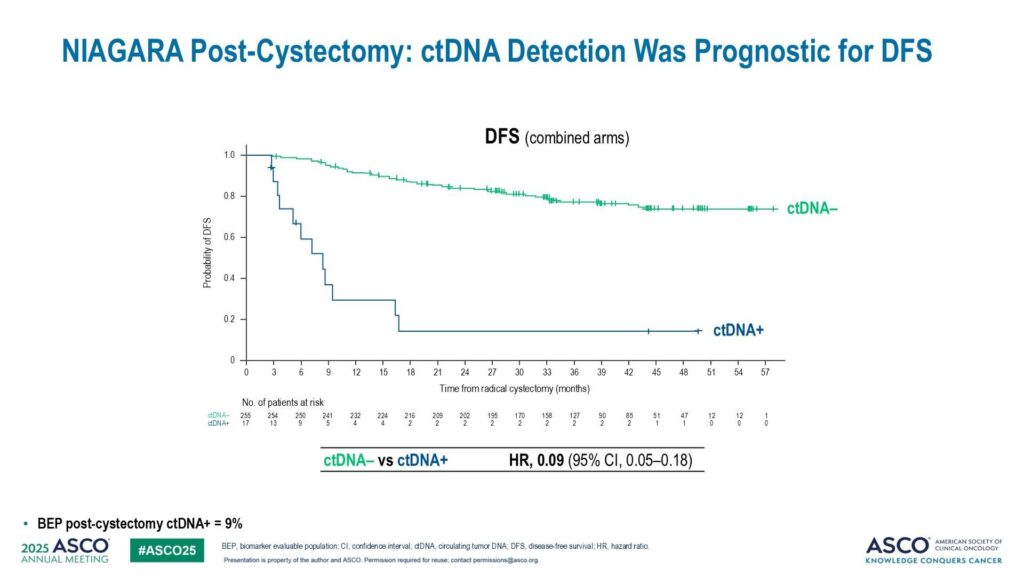
Kaplan-Meier disease-free survival curves for patients with detectable and undetectable ctDNA after neoadjuvant gemcitabine, cisplatin, durvalumab and radical cystectomy in the NIAGARA trial.
Figure 2. NIAGARA ctDNA DFS data
Future Directions
With IMVigor011 paving the way, the integration of ctDNA into treatment decision making has just begun. Dr. Pal brought up the MODERN trial, describing it as a large cooperative group effort that implements a risk-adapted treatment paradigm based on ctDNA status. MODERN investigates whether ctDNA can serve as a platform for intensification and de-intensification after cystectomy. Patients with detectable ctDNA are randomized to either nivolumab or intensified therapy with nivolumab and relatlimab. Those with negative ctDNA are randomized to either 12 cycles of nivolumab or ctDNA-guided adjuvant nivolumab, in a non-inferiority design. Results from MODERN will establish a framework for further intensification and de-intensification studies. ctDNA and urinary tumor DNA (utDNA) are also being utilized to select appropriate patients for bladder preservation. Upcoming bladder preservation trials use undetectable ctDNA and utDNA, along with other indicators of response, in their definition of clinical complete response (cCR). Those achieving cCR may safely keep their bladders with close surveillance.
The pace of change in MIBC has been rapid. Nevertheless, results from NIAGARA and IMVigor011 show that ctDNA will be integral in MIBC treatment. Further improvements in ctDNA assay sensitivity will aid clinicians in making important therapeutic decisions. Upcoming clinical trials will examine whether ctDNA can guide treatment intensification, de-escalation, and bladder preservation, actively integrating precision medicine to improve patient outcomes.
References
1. Powles T, Kann AG, Castellano D, et al. ctDNA-guided adjuvant atezolizumab in muscle-invasive bladder cancer. N Engl J Med. 2025;393(24):2395–2408. doi:10.1056/NEJMoa2511885
2. Powles T, Van der Heijden MS, Wang Y, et al. Circulating tumor DNA (ctDNA) in patients with muscle-invasive bladder cancer (MIBC) who received perioperative durvalumab (D) in NIAGARA. J Clin Oncol. 2025;43:4503. doi:10.1200/JCO.2025.43.16_suppl.4503