

Insights from ASCO 2026: Antibody–Drug Conjugates Continue to Reshape Metastatic Triple-Negative Breast Cancer

Key Points
- ASCENT-04 and TROPION-Breast02 data from ASCO 2026 support antibody–drug conjugates as a new backbone in first-line metastatic triple-negative breast cancer (TNBC).
- Sacituzumab govitecan plus pembrolizumab demonstrated durable progression-free survival benefits in PD-L1–positive disease compared with chemotherapy-based regimens.
- Datopotamab deruxtecan showed an overall survival advantage over chemotherapy in patients with metastatic TNBC ineligible for immunotherapy, establishing a new treatment option.
The antibody-drug conjugate (ADC) landscape across oncology, particularly in breast oncology, continues to rapidly evolve. The 2026 American Society of Clinical Oncology Annual Meeting (ASCO 2026) provides important updates from the phase 3 trials, ASCENT-04 and TROPION-Breast02. Together, these trials reinforce the growing role of TROP2-directed ADCs across metastatic TNBC, while raising important questions regarding sequencing, patient selection, and the future integration of ADCs with immunotherapy.
ASCENT-04: Durable Benefit Extends Beyond First Progression
The ASCENT-04/KEYNOTE-D19 trial (NCT05382286) established sacituzumab govitecan (SG) plus pembrolizumab as a potential new standard of care for previously untreated PD-L1-positive (CPS ≥10) locally advanced or metastatic TNBC, with primary results published in the New England Journal of Medicine earlier this year showing a 35% reduction in the risk of disease progression or death compared with chemotherapy plus pembrolizumab (HR, 0.65; median progression-free survival [PFS] 11.2 months vs 7.8 months). At ASCO 2026, the conversation shifted to durability.
A key updated analysis presented by Kevin Kalinsky, MD, MS, FASCO, of Winship Cancer Institute of Emory University, evaluated PFS after the next line of treatment (PFS2). At a median follow-up of 14 months, the median PFS2 was not reached in the SG/pembrolizumab arm versus 21 months in the chemotherapy/pembrolizumab arm, which translates to a 33% reduction in the risk of a PFS2 event (HR, 0.67; 95% CI, 0.48–0.95).1
An important aspect is the durability of benefit despite significant crossover, with 81% of patients in the chemotherapy arm who received subsequent therapy went on to receive SG. The PFS2 advantage held, and time to first subsequent treatment was meaningfully delayed at 17.3 versus 9.8 months (HR, 0.59), reinforcing the durability of frontline ADC-immunotherapy in delaying the need for subsequent lines.
A biomarker subgroup analysis presented by Sara Tolaney, MD, MPH, of Dana-Farber Cancer Institute, shows consistent benefit across TROP2 H-score quartiles, even patients in the lowest quartile had comparable PFS (9.3 months vs 9 months).2 This suggests that TROP2 expression level alone should not be used to withhold this regimen.
The most frequent grade 3 or 4 adverse events (AEs) with SG plus pembrolizumab were neutropenia (43%) and diarrhea (10%) compared with neutropenia (45%), anemia (16%), and thrombocytopenia (14%) in the chemotherapy arm. Treatment discontinuation because of AEs was notably lower in the ADC arm at 12% versus 31% in the chemotherapy arm, a clinically meaningful difference that further supports tolerability in real-world practice.
“Multiple trials over the last few years are showing a trend towards improved patient outcomes when regimens containing an ADC or immunotherapy are utilized in earlier lines of therapy instead of delaying to later lines,” said Kate Lathrop, MD, of UT Health San Antonio/Mays Cancer Center. “ASCENT-04 is giving us the option of combining an immunotherapy and ADC in the first line metastatic setting with both improved PFS and a favorable toxicity profile compared to chemotherapy containing regimens.”
TROPION-Breast02: OS Benefit Establishes a New Standard for Immunotherapy-Ineligible Patients With Metastatic TNBC
TROPION-Breast02, presented at the 2025 European Society for Medical Oncology Congress and FDA-approved in May 2026, is establishing a new standard for patients with metastatic TNBC who are not eligible for PD-1/PD-L1 inhibitor therapy, a population historically limited to single-agent cytotoxic therapies.
Additional efficacy end point data were presented at ASCO 2026 by David Cescon, MD, PhD, of Princess Margaret Cancer Centre.3 The trial met both primary end points: the median PFS was 10.8 months with datopotamab deruxtecan (Dato-DXd) versus 5.6 months with chemotherapy (HR, 0.57; P < .0001), and at a median follow-up of 27.5 months, the median overall survival (OS) was 23.7 versus 18.7 months (HR, 0.79; P = .0291). A 5-month improvement in median OS over chemotherapy in this difficult-to-treat population is a landmark result. Dato-DXd is the first therapy to demonstrate a statistically significant OS benefit over chemotherapy in immunotherapy-ineligible mTNBC.
The key secondary end points, including median time to first subsequent treatment, favored Dato-DXd at 10.9 versus 5.6 months (HR, 0.49) and PFS2 extended to 15.6 versus 11.8 months (HR, 0.61), supporting durability of benefit beyond first progression.
The most common treatment-related adverse events in the Dato-DXd arm included stomatitis (57% any grade; 8% grade ≥3), nausea (45%), and dry eye (24%). Despite more than double the duration of treatment in the Dato-DXd arm, rates of grade 3 or higher AEs were similar to those in the chemotherapy arm, but treatment discontinuations were lower.
“With similar numbers of patients receiving second-line therapy (~75%) and nearly 2x as many receiving second-line ADC in the investigator’s choice of chemotherapy (ICC) arm (ICC 41% vs Dato-Dxd 21%) the benefit of first-line Dato-Dxd was sustained,” said Stephanie L. Graff, MD, FACP, FASCO, of Brown University Health Cancer Center.
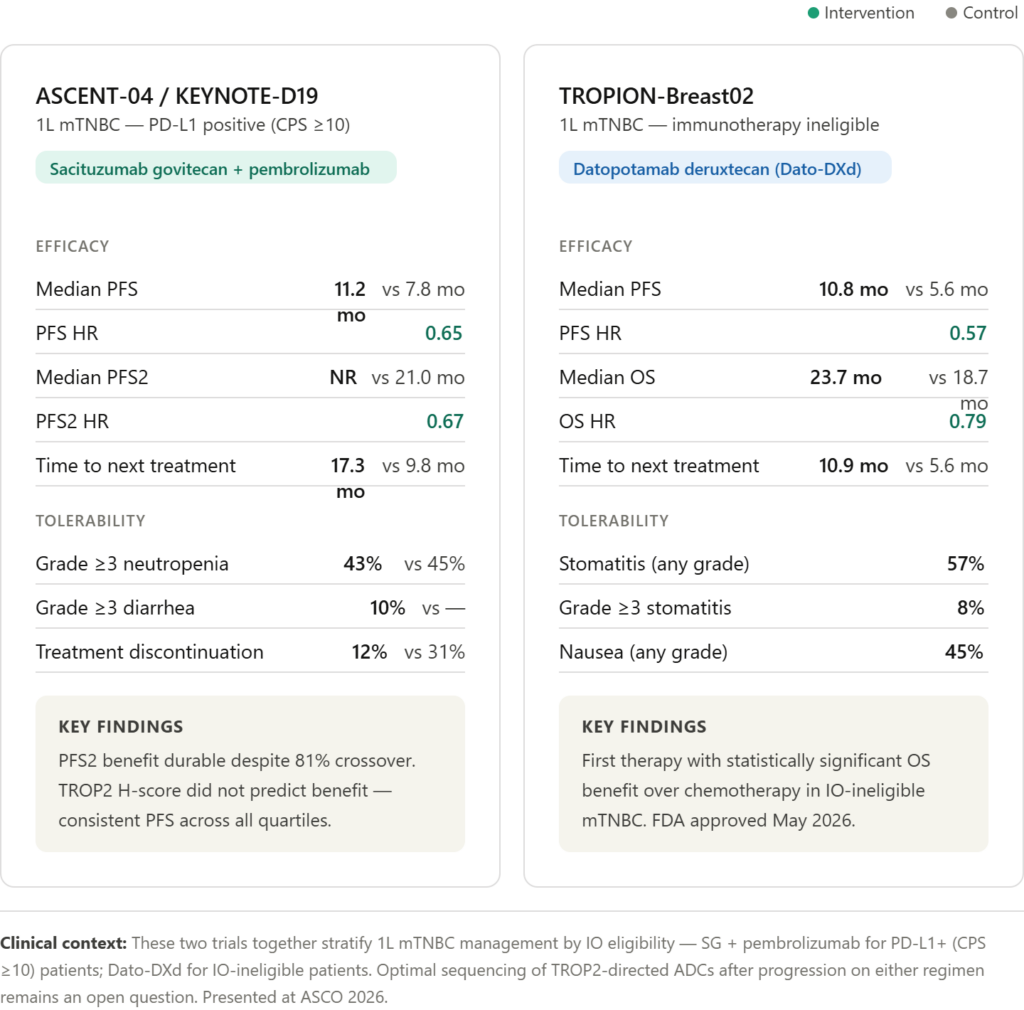
Figure 1. ASCO 2026: ASCENT-04 versus TROPION-Breast02
The Evolving ADC Landscape: Clinical Implications
Data from ASCENT-04 and TROPION-Breast02 collectively represent a shift in first-line metastatic TNBC management. The historical paradigm of a chemotherapy backbone with or without pembrolizumab has made way for ADC-anchored strategies stratified by immunotherapy eligibility.
For PD-L1-positive patients (CPS ≥10), the combination of SG plus pembrolizumab offers a chemotherapy-free ADC/immuno-oncology (IO) backbone with durable PFS and manageable toxicity profile. For PD-L1-negative patients or patients contraindicated for immunotherapy, Dato-DXd provides the first OS-proven alternative to cytotoxic chemotherapy.
Optimal sequencing of TROP2-directed ADCs: SG following Dato-DXd progression and vice versa remains an unanswered clinical question. Correlative analyses from both trials continue to look at the predictive value of TROP2 expression, germline BRCA status, and other biomarkers as tools for refining patient selection. The anticipated expansion of ADC/IO combinations into earlier disease settings raises important prospective questions about sequencing these regimens and cross-resistance with established neoadjuvant and adjuvant regimens. What is clear from ASCO 2026 is that the ADC era in breast oncology is no longer emerging; it has arrived.
References
- Kalinsky K, Schmid P, de Azambuja E, et al. Progression-free survival after next line of treatment and subsequent therapies in the ASCENT-04 study of participants with previously untreated PD-L1–positive metastatic triple-negative breast cancer treated with sacituzumab govitecan plus pembrolizumab vs chemotherapy plus pembrolizumab. J Clin Oncol. 2026;44(17_suppl):LBA1000. Presented at: American Society of Clinical Oncology Annual Meeting; June 2026; Chicago, Illinois.
- Tolaney SM, Schmid P, de Azambuja E, et al. Sacituzumab govitecan plus pembrolizumab vs chemotherapy plus pembrolizumab in previously untreated PD-L1–positive metastatic triple-negative breast cancer: biomarker subgroup analyses from the phase 3 ASCENT-04/KEYNOTE-D19 study. J Clin Oncol. 2026;44(16_suppl):1013. Presented at: American Society of Clinical Oncology Annual Meeting; June 2026; Chicago, Illinois.
- Cescon DW, Traina TA, Schmid P, et al. First-line datopotamab deruxtecan vs chemotherapy in locally recurrent inoperable or metastatic triple-negative breast cancer: additional efficacy endpoints from the phase 3 TROPION-Breast02 study. J Clin Oncol. 2026;44(16_suppl):1002. Presented at: American Society of Clinical Oncology Annual Meeting; June 2026; Chicago, Illinois.